


Small Business Guide to Refrigeration Maintenance

A walk-in cooler that runs a few degrees warm can turn into lost inventory, an unhappy health inspector, and a busy day spent calling vendors instead of serving customers. This small business guide to refrigeration maintenance covers the practical checks that help restaurants, markets, florists, medical offices, and other New Jersey businesses keep critical equipment dependable.
Refrigeration maintenance is not about trying to repair every problem yourself. It is about knowing what your staff can watch for, keeping equipment clean and properly loaded, and calling a qualified refrigeration technician before a small issue becomes an emergency. A little attention can extend equipment life, control energy costs, and protect the products your business depends on.
Why refrigeration maintenance deserves a schedule
Commercial refrigeration equipment works hard around the clock. Unlike a comfort cooling system that may run less during mild weather, a reach-in cooler, freezer, ice machine, or walk-in may have no real downtime. Heat, grease, dust, frequent door openings, and heavy product loads all add strain.
When maintenance gets skipped, the usual result is not an immediate shutdown. The system may run longer, struggle to hold temperature, develop ice buildup, or make more noise than usual. Those are early warnings. Waiting until the box is warm often means a more expensive repair, product loss, and disruption during business hours.
A maintenance plan also gives an owner a record of temperatures, service visits, and recurring issues. That information is useful when deciding whether a repair still makes financial sense or replacement is the better long-term move.
Daily and weekly refrigeration checks for staff
Your team does not need to be refrigeration experts to help prevent trouble. They do need a short, consistent routine. Assign responsibility to a manager or opening employee, especially for equipment holding food, medication, flowers, or other temperature-sensitive stock.
Check and record the internal temperature at least once each day. Do not rely only on the display panel. A separate thermometer inside the cooler or freezer provides a useful second reading. Refrigerators generally need to hold 41°F or below for food safety, while freezer targets vary by product but are commonly around 0°F. Follow applicable health rules and product storage requirements for your operation.
Watch for these common signs during normal use:
Doors that do not close fully or gaskets that are torn, loose, dirty, or flattened
Water on the floor, excessive condensation, or frost inside the cabinet
Unusual buzzing, rattling, clicking, or a compressor that seems to run constantly
Slow recovery after deliveries, warm product zones, or a temperature reading that keeps drifting
Dirty condenser areas, blocked vents, or boxes stacked against airflow openings
Staff should report these conditions right away. Do not ignore a small puddle or a door gasket that has started to crack. Both can force a refrigeration system to work much harder than it should.
Keep doors, gaskets, and airflow clear
The simplest maintenance task is also one of the most valuable: keep doors closed and sealing correctly. Every long door opening brings warm, humid air into the cabinet. That heat has to be removed by the system, and the moisture can turn into frost.
Wipe door gaskets with mild soap and water, then dry them thoroughly. Avoid harsh cleaners that can damage rubber. Test the seal by closing the door on a sheet of paper. If the paper slides out with almost no resistance, the gasket may not be sealing well.
Inside the unit, do not pack products tightly against evaporator covers, fans, or air vents. Overloading a cooler can reduce circulation and create warm spots, even when the thermostat appears normal. Leave room for air to move around product, and allow hot items to cool properly before placing them inside when your process permits.
Monthly tasks that reduce breakdowns
A monthly check is a good time to look beyond daily operation. Start by inspecting the area around the equipment. Cardboard, grease, dust, and storage clutter can block airflow to the condenser or make service access difficult. Walk-ins and remote condensers need clear space around their components as well.
Clean interior shelves, drain areas, and accessible surfaces. Standing water and debris can lead to odors, drain issues, and sanitation concerns. If an ice machine is part of your operation, follow its manufacturer cleaning and sanitizing requirements. Ice is food, and neglect can affect both machine performance and cleanliness.
Condenser coil cleaning matters, but it is not always a do-it-yourself job. On some equipment, coils are easy to access and can be carefully vacuumed or brushed. Others are located in tight spaces, behind panels, or near electrical components. Grease-laden restaurant environments also require more than a quick dusting. Using the wrong method can bend fins, push dirt deeper into the coil, or damage equipment.
If you are not certain how to access and clean a coil safely, schedule professional service. A dirty condenser is one of the most common causes of high energy use, overheating, and compressor failure.
What a professional refrigeration maintenance visit should cover
A qualified technician does more than wipe down a unit and confirm it turns on. Professional maintenance should focus on the parts that affect cooling performance, electrical safety, and equipment longevity.
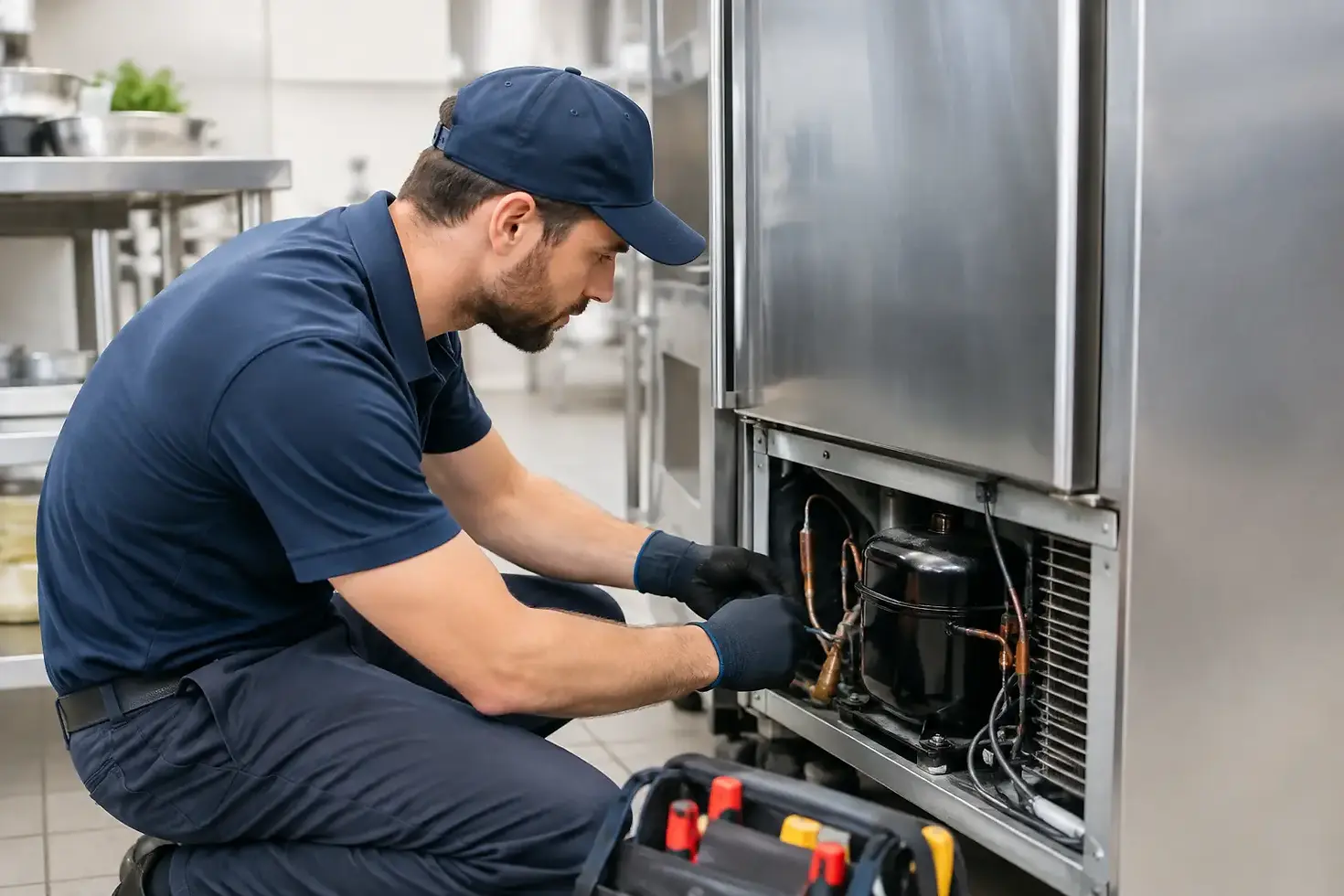
During a service visit, the technician may clean condenser and evaporator components as needed, inspect fan motors and blades, check belts where applicable, clear and test drains, inspect door hardware and gaskets, and verify controls and defrost operation. They should also inspect wiring, electrical connections, contactors, capacitors, and compressor operation.
Refrigerant pressures and temperatures can reveal issues that are not obvious from the outside, including a restriction, undercharge, airflow problem, or failing component. Refrigerant work should always be handled by a properly qualified technician. Adding refrigerant without finding the reason it is low is not a repair. Refrigerant does not get used up under normal operation, so a low charge can point to a leak or another system problem.
The right maintenance frequency depends on the equipment and how hard it works. A lightly used office refrigerator may need less attention than a busy restaurant walk-in, ice machine, or display case exposed to heat and grease. Many small businesses benefit from professional service twice a year, while demanding applications may need quarterly visits.
Know when to call for repair instead of waiting
Some issues need prompt service, even if the equipment is still running. Call for refrigeration repair when temperatures cannot be maintained, the compressor short-cycles, frost returns soon after cleaning, the unit trips breakers, or there is a burning smell. Water leaks, oil residue around refrigeration lines, and loud mechanical noises also deserve a professional inspection.
If a cooler temperature rises, protect inventory first. Keep the door closed as much as possible, move critical product to another verified cold unit if available, and document temperatures according to your safety procedures. Do not keep resetting breakers or changing control settings repeatedly in an attempt to force the system to run. Those actions can mask the problem or create additional damage.
For businesses in Ocean County, Tabernacle, and nearby New Jersey communities, ComfortCare Heat & Air provides refrigeration service with the same straightforward approach used for heating and cooling work: show up, diagnose the issue honestly, and get the equipment back to dependable operation.
Repair or replacement: make the decision with real numbers
Older refrigeration equipment can often be repaired, but age alone should not decide the issue. Consider repair when the unit has been reliable, the cabinet or walk-in structure is in good condition, and the problem is isolated. A failed fan motor, gasket, control, or capacitor can be a sensible repair when the rest of the system is sound.
Replacement deserves a serious conversation when repairs are frequent, temperatures are inconsistent, the compressor has failed on an aging unit, or energy bills have climbed with no clear operational change. Parts availability also matters. Older equipment may use obsolete controls or refrigerants that make future service more difficult and costly.
Ask for a clear explanation of the repair, the expected remaining life of the equipment, and the likely operating costs of keeping it versus replacing it. The cheapest immediate option is not always the lowest-cost business decision.
A refrigeration system rarely picks a convenient time to fail. Build simple checks into your staff routine, keep service areas accessible, and address warning signs while the equipment is still holding temperature. That is how a small business protects inventory, avoids preventable emergencies, and keeps customers served.


Comments